Kei Truck: Models, Cost, Legality & Buying Guide (2026)

You have five acres, a barn to maintain, and trails too tight for a full-size pickup. A UTV costs $15,000 and can’t legally touch a public road. A golf cart dies in mud. This is exactly the problem the Kei truck was built to solve and why more than 30,000 of them have landed in the United States since 2020.
This guide covers everything: what a kei truck is, how Honda, Suzuki, Subaru, and Toyota models compare, what the full landed cost looks like in 2026, which states let you drive one on public roads, and what to check before handing over a single dollar.
What Is a Kei Truck?
A kei truck, called a keitora in Japan, is a compact cab-over utility pickup built to Japan’s keijidosha (light vehicle) regulations. The rules are tight: engine displacement maxes out at 660 cc, overall length caps at 3.4 meters, and width stops at 1.48 meters.
Those constraints produce something genuinely useful: a truck that weighs around 700 kg, carries up to 770 lbs of cargo, and fits through a barn door a full-size F-150 would demolish.
The cab-over layout puts the cab directly above the front axle rather than behind an engine bay. That design is what makes a 6-foot flatbed possible despite the compact footprint. Fold-down sides, dump beds, and scissor-lift variants extend the utility further depending on the job.
The kei class has evolved through several regulatory revisions since 1949 — if you want the full legislative timeline, the kei truck history on Wikipedia covers every generation from the Kurogane Baby through modern production.
Kei trucks trace their roots to Japan’s postwar economic recovery. In the late 1940s, the Japanese government created the keijidosha class to stimulate domestic vehicle ownership and manufacturing.
The first true kei truck, the Kurogane Baby, went on sale in 1959. Daihatsu, Suzuki, Honda, Subaru, and Mitsubishi followed through the 1960s and kept refining the platform across the decades that followed.
Today, close to one-third of all new vehicles sold in Japan fall under the kei classification. The rest of the world is catching up, including American kei truck buyers who have made this the fastest-growing import vehicle category in the US market.
Top Kei Truck Models Compared
Five manufacturers dominate the US import market. Each works within the same regulatory framework but takes a distinct engineering approach. Here is what actually separates them.
Honda kei truck | the Acty
The Honda Acty positions its engine amidships, behind the cab and ahead of the rear axle. That mid-engine layout gives the Acty the lowest center of gravity in the class, which produces go-kart-like handling on tight terrain.
Second-generation Acty trucks (1988–1999) make up the bulk of US imports; EFI versions produce around 38 horsepower and 40 lb-ft of torque from a 660cc three-cylinder.
Two factory variants are worth tracking down specifically. The Acty Attack ships with low-range gearing and a locking differential from the factory.
The Acty Crawler, rare and actively sought, adds a six-wheel setup with tracks for extreme traction situations. Honda ended Acty production in 2021, which means clean examples only get harder to find from here.
Best for: property owners who want road manners alongside utility.
Suzuki kei truck | the Carry
The Suzuki Carry is the most imported kei truck in the United States. Its selectable 4WD with low-range gearing makes it the strongest off-road platform in the segment, and its global parts network means you can source almost anything without waiting weeks for a Japan shipment.
The fuel-injected 660cc three-cylinder produces 41 horsepower, not impressive on paper, but the Carry’s reputation rests on durability, not output figures. The ninth-generation model (1991–1999, rectangular headlights) offers more interior space and remains the most popular canvas for modified kei truck builds.
Best for: farm work, construction sites, and anyone planning a lift kit or trail build.
Subaru kei truck | the Sambar
The Subaru Sambar puts its engine all the way at the rear, directly above the rear drive wheels. That layout delivers exceptional 2WD traction and a noticeably quieter cabin; the drivetrain sits away from the occupants, so road and engine noise stay muted.
The 1990–1998 generation moved to a four-cylinder “Clover-4” engine making 39–46 horsepower in standard trim or around 55 horsepower with the factory supercharger fitted. Those supercharged Sambars attract a dedicated following and command a price premium in 2026.
The rear-engine position reduces rear ground clearance, so the Sambar suits farm lanes and estate tracks better than aggressive off-road terrain.
Best for: buyers who want the most comfortable ride in the class and appreciate unconventional engineering.
Toyota kei truck | the Pixis Truck
Toyota does not engineer a kei truck independently. The Toyota kei truck sold in Japan the Pixis Truck is a rebadged Daihatsu Hijet, produced by Toyota’s subsidiary and sold through Toyota dealerships. The two vehicles are mechanically identical.
Buyers searching for a Toyota kei truck are effectively buying a Hijet under different badges, which matters because every part, service manual, and technical resource belongs to the Daihatsu ecosystem, not Toyota’s.
Daihatsu Hijet
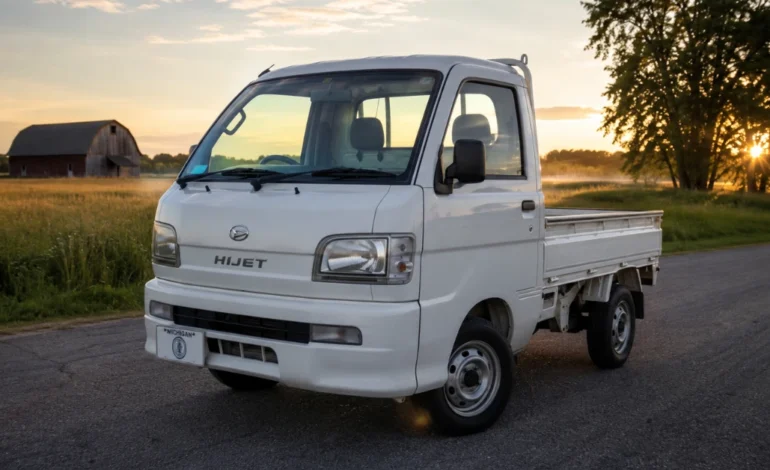
The Hijet has the longest continuous production run of any kei truck and the widest factory bed configuration range: standard flatbed, dump bed, scissor lift, Jumbo Cab with extra headroom for taller drivers, and refrigerated van body.
The eighth-generation Hijet (1994 onward) offered a turbocharged variant producing 63 horsepower, the most powerful widely available kei truck. The off-road Hijet Climber adds body cladding, extra ground clearance, and locking differentials for buyers who want trail capability without building it themselves.
Best for: commercial and daily work use, taller drivers, and anyone who needs a specialist bed configuration.
Mitsubishi Minicab
The fifth-generation Minicab (1991–1999) is the segment’s value pick. Fuel-injected versions produce up to 47 horsepower from a four-valve 660cc three-cylinder.
The Minicab offers the lowest entry prices across the segment and pairs with an automatic transmission more often than any other kei brand, a practical advantage for buyers who prefer not to manage a manual in tight working conditions. Low-end torque is its strength; it hauls steadily without needing to rev hard.
Best for: budget-conscious buyers who need reliable 4WD at the lowest total cost.
Model comparison
| Model | Engine Layout | Cylinders | Max HP | 4WD Type | Best Use Case |
|---|---|---|---|---|---|
| Honda Acty | Mid-engine | 3-cyl | ~38 hp | Real-time 4WD | Road handling + property work |
| Suzuki Carry | Mid-chassis | 3-cyl | ~41 hp | Selectable + low range | Off-road + modifications |
| Subaru Sambar | Rear-engine | 4-cyl | ~46 hp (55 hp SC) | Selectable | Comfort + traction |
| Toyota Pixis (= Hijet) | Mid-chassis | 3-cyl | ~63 hp (turbo) | Selectable + low range | Commercial + tall drivers |
| Daihatsu Hijet | Mid-chassis | 3-cyl | ~63 hp (turbo) | Selectable + low range | Versatility + specialist beds |
| Mitsubishi Minicab | Mid-chassis | 3-cyl | ~47 hp | Selectable | Budget hauling |
Kei Truck Top Speed, Performance & Fuel Economy
The Kei truck’s top speed sits between 50 and 75 mph, depending on the model, generation, and whether the engine was governed for the Japanese domestic market.
Above 65 mph, most kei trucks become noticeably less settled; the narrow track width and relatively tall cab create real aerodynamic limitations at highway pace. Plan your routes around roads where 55 mph or under is realistic.
Where these trucks deliver real advantages is fuel economy. In stop-and-go farm or site work, expect 28–35 MPG. On steady road runs with a moderate load, many models reach 37–47 MPG. A V8 pickup doing the same work returns 14–18 MPG. Over 10,000 working miles per year, that gap translates to $1,500–$2,500 in fuel savings annually at current prices.
The reason is not complex engineering; it is weight. A kei truck weighs less than a quarter of a loaded F-150. Physics does what horsepower cannot.
Kei Truck Cost: Purchase Price + Full Import Breakdown
The kei truck cost picture has two distinct layers: what you pay for the vehicle in Japan, and what it costs to get it to your driveway in 2026.
Vehicle price in Japan
Used Kei trucks at Japanese domestic auctions, where most US import stock originates, sell for $1,000–$7,000 USD before export. Condition, mileage, 4WD specification, and model year drive the range. On export platforms like BeForward, higher-quality low-mileage examples list from $2,500 to $9,000 before shipping.
New 2025 and 2026 Daihatsu Hijet models are now arriving through US importers, with full landed prices in the $12,000–$18,000 range, depending on specification.
Full landed cost breakdown
| Cost Item | Typical Range (2026) |
| Vehicle Purchase Price | $2,000 – $9,000 |
| Ocean Freight to US Port | $1,500 – $3,000 |
| ISF 10+2 Filing Fee | $25 – $115 |
| US Import Duty (Chicken Tax on Trucks) | 25% of FOB Price |
| DOT/EPA Reporting Fee | ~$70 |
| Port Handling / Harbour Maintenance Fee | $90 – $200 |
| Transport from Port to Your Location | $300 – $800 |
| State Registration and Sales Tax | Varies by State |
On a $4,000 vehicle, the 25% Chicken Tax adds $1,000 before anything else. A solid used kei truck typically lands at your door for $7,500–$14,000 total, depending on port, state, and distance from the port of entry.
Are Kei Trucks Street Legal? State-by-State Breakdown
The federal 25-year rule is where legality starts. Under US federal law, any vehicle manufactured 25 or more years ago, calculated from the exact production date, not the model year, can be imported without meeting the FMVSS or EPA emissions standards that applied at manufacture. That makes most 1999 and earlier kei trucks import-eligible right now in 2026.
The NHTSA’s official 25-year import exemption guidance spells out exactly how the rule applies and what documentation you need to import a non-compliant vehicle.
Federal import eligibility does not equal state road legality. States set their own registration and road-use rules independently.
| State status | Examples | Notes |
| Permissive road legal | Texas, Florida, Oklahoma, Louisiana, Arkansas, North Carolina | Registration available; some limit use to roads under 55 mph |
| Restricted county or road-type variation | Kansas, Montana, Tennessee, Virginia, New Hampshire | Confirm at the county DMV level before purchasing |
| Significant restrictions or bans | Pennsylvania, Rhode Island, Maine | Maine is the most restrictive, effectively banning kei trucks from all public road use |
State laws shift. Always verify directly with your state DMV before purchasing. For private land-use farms, estates, campuses, and ranches, state road legality is irrelevant. American kei truck owners operate freely on private property regardless of their state’s public road rules.
If road access matters to you, buy in or register in a permissive state. If you only need a property workhorse, buy wherever it gives you the best price.
Kei Truck vs UTV / Side-by-Side: Which One Actually Fits Your Situation?
This comparison does not appear in any major competitor article, which is why buyers keep searching for it. Here is a direct answer.
| Factor | Kei Truck | UTV / Side-by-Side |
| Purchase Price (2026) | $7,500 – $14,000 landed used | $10,000 – $22,000 new |
| Payload Capacity | ~770 lbs | 400 – 1,000 lbs (varies by model) |
| Road Legal in Permissive States | Yes | No off-road only |
| Fuel Economy | 28 – 47 MPG | 15 – 25 MPG (gas models) |
| Top Speed | 50 – 75 mph | 35 – 60 mph |
| Ground Clearance (Stock) | 7 – 9 inches | 10 – 13 inches |
| Full Enclosed Cab | Yes | No open or half-cab |
| Parts Availability | Strong via Japan + US importers | Strong via dealer networks |
| Licence and Registration Required | Yes (where road legal) | No for off-road use |
Pick a Kei truck if you need road legality, a fully enclosed cab for all-weather work, better fuel economy, or a flatbed that handles full sheets of plywood. Pick a UTV if extreme ground clearance is the priority, you work exclusively off-road on rough terrain, or you want a roll cage for aggressive trail use at speed.
For most American kei truck buyers, farmers, homesteaders, property managers, and landscapers, the kei truck wins on total cost of ownership, weather protection, road flexibility, and payload. The UTV wins in the ditch.
What to Check Before Buying a Kei Truck
The biggest risk in this market is not mechanical failure; it is buying a truck that has been misrepresented. These specific issues come up often enough that every buyer should check them before committing.
Odometer readings. Japan’s progressive vehicle tax structure encourages businesses to declare trucks surplus after a short commercial life. Some export brokers have manipulated odometers on trucks being prepped for overseas sale.
A truck showing 22,000 miles that has actually covered 90,000 miles needs significant mechanical attention shortly after arrival. Cross-check displayed mileage against interior wear, pedal wear, and consistency of any available service records.
Auction spray jobs. Small operations buy trucks at Japanese domestic auctions, apply a cosmetic respray, and flip them for export without addressing frame rust or mechanical wear underneath. Study the undercarriage photos carefully in any listing. Surface rust on a 25-year-old kei truck is normal. Rust on frame rails or floor pans is a structural issue that matters.
Shaken inspection records. Japan’s biennial Shaken inspection is a rigorous roadworthiness test covering brakes, emissions, lighting, chassis integrity, and safety systems. A truck that passed Shaken recently carries state-verified documentation of roadworthiness.
A truck being exported without shaken papers, especially if the last recorded inspection was more than three years ago warrants extra scrutiny. Ask for the certificate before agreeing to purchase.
Timing belt history. Most kei-truck engines use a timing belt rather than a timing chain. Replacement intervals run every 60,000–80,000 miles. An unserviced belt on a truck with uncertain mileage history is a genuine failure risk. Budget $300–$600 for a timing belt service on arrival if you cannot verify the last replacement date.
Parts availability check. Before committing to any specific model, spend 20 minutes on amayama.com, a Japanese parts database with illustrated exploded diagrams and real retail pricing.
Check what common wear items cost and whether they ship internationally. For a modified kei truck with aftermarket parts already fitted, confirm the modifications do not affect your state’s registration process before purchase.
Common Kei Truck Uses & Modifications
In the US, kei trucks work hardest in roles where full-size vehicles are simply impractical. Farm and property maintenance, landscaping runs, hunting trail access, golf course and campus transport, and light commercial delivery in road-legal states are the most common applications.
The modification scene has grown sharply alongside rising import numbers. Popular builds include 2–4 inch lift kits, all-terrain tyre upgrades, roof rack systems for hunting and overlanding gear, snorkel kits for creek crossings, and flatbed-to-dump conversion kits.
A purpose-built modified kei truck for farm trail access typically comes together for $10,000–$13,000 total purchase price, shipping, import costs, and modifications included. That undercuts a comparable UTV setup by a meaningful margin.
The Daihatsu Hijet Climber and Honda Acty Attack arrive from the factory already configured for this kind of use, making them the premium targets for buyers who want capability without the build time.
Frequently Asked Questions
How fast does a kei truck go?
The Kei truck’s top speed is typically 50–75 mph, depending on the model and condition. Most are comfortable and stable under 65 mph. They are not built for sustained highway travel.
Is buying a kei truck worth it in 2026?
For farm work, property maintenance, and off-road utility on private land, yes. The combination of low purchase cost, low fuel cost, and genuine cargo capacity is hard to match at this price point. For highway commuting or heavy towing, they are the wrong tool.
Does Toyota make a kei truck?
Toyota sells the Pixis Truck in Japan, but it is a rebadged Daihatsu Hijet built by Toyota’s subsidiary. There is no Toyota-engineered kei truck. All parts, service manuals, and technical resources belong to the Daihatsu ecosystem.
What is the 25-year rule for kei trucks?
A US federal regulation that permits vehicles 25 years or older from the exact production date to be imported without meeting the FMVSS safety and EPA emissions standards that applied at manufacture. Most 1999 and earlier kei trucks qualify for import today in 2026.
How much does it cost to import a Kei truck in 2026?
Total landed cost runs $7,500–$14,000 for a solid used example. That figure includes the vehicle, ocean freight, the 25% Chicken Tax import duty, ISF filing, port charges, and transport from the port to your location.
Do Kei trucks come with air conditioning?
Depends on trim level and year. AC was available as an option on most models from the early 1990s onward, but was not fitted as standard on base trims. Filter for AC when browsing export listings; it is a searchable specification on most platforms.
What is the best Kei truck for off-road use?
The Suzuki Carry with selectable 4WD and low-range gearing is the most popular platform for off-road and modified kei truck builds. The Daihatsu Hijet Climber and Honda Acty Attack are strong factory-ready alternatives that need less work out of the box.
Can I modify a kei truck?
Yes. Lift kits, tire upgrades, roof racks, and bed conversions are all available. The Suzuki Carry has the deepest aftermarket parts ecosystem of any model in the segment. Before purchasing a truck that already has modifications fitted, confirm that those changes do not create problems with your state’s registration requirements.
The Bottom Line
The kei truck is not a novelty item. It is a purpose-built utility machine that solves a specific problem: tight spaces, low running costs, and real cargo capacity better than anything else at its price point.
More than 30,000 have arrived in the United States since 2020 because the value case is straightforward: you get a reliable, fuel-efficient flatbed that goes where larger vehicles cannot for a landed cost that undercuts a new UTV by thousands of dollars.
Buy the right model for your use case, confirm your state’s road rules before committing, and do the due diligence on the condition before the truck leaves Japan. Get those three things right, and a kei truck will work hard for you for years.