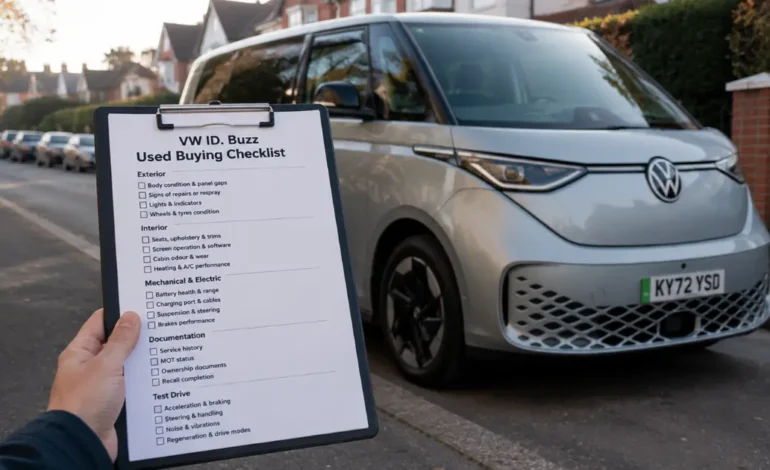
VW ID. Buzz Used Buying Checklist: High Mileage Guide for UK Buyers

The VW ID. Buzz is the most talked-about electric MPV on UK roads right now, but buying one used, especially at higher mileage, is a completely different proposition to picking up a second-hand Golf.
Battery health, software version, wheelbase confusion, and a used price guide that shifts every month all stand between you and a good deal. This checklist covers every step a UK buyer needs to take before signing anything on a high-mileage example.
A used VW ID. Buzz with high mileage is worth buying if the MEB battery retains above 80% state of health, all over-the-air software updates are confirmed as applied, and a full HPI check and MOT history come back clean. This guide walks you through every step in the right order.
What Counts as “High Mileage” on a VW ID. Buzz?
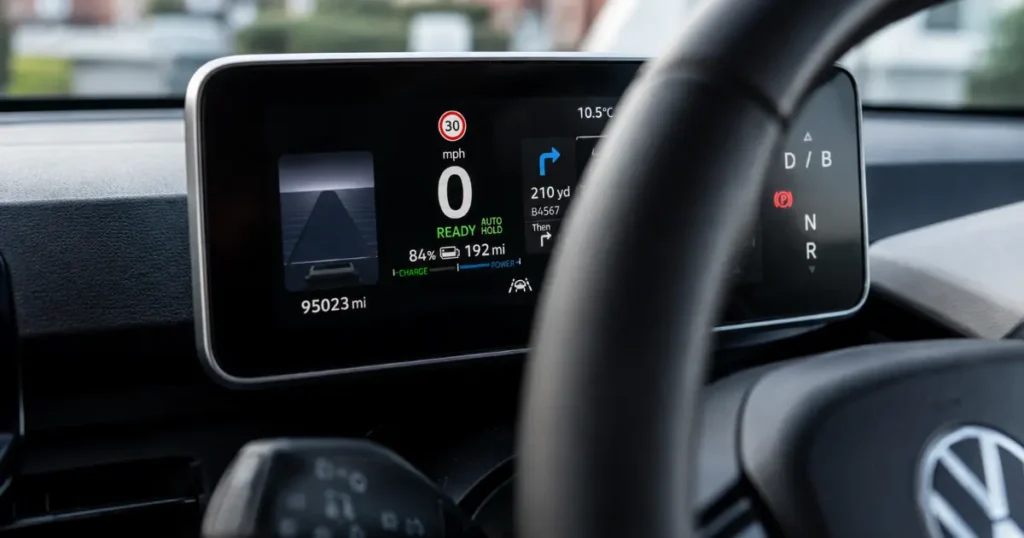
Electric vehicles age differently from petrol cars. On a conventional used car, 80,000 miles raises immediate questions about engine wear and service costs. On an ID. Buzz, the drivetrain is far less of a concern than one component: the battery pack.
Here is how to think about mileage bands on a used ID. Buzz:
- Under 30,000 miles: low mileage, minimal battery degradation expected, but expect to pay a premium
- 30,000–60,000 miles: the sweet spot; acceptable degradation, growing used supply, best value
- 60,000–100,000 miles: high mileage, a battery diagnostic is essential before purchase
- 100,000+ miles: expert inspection only; battery warranty may be approaching its limit
The ID. Buzz runs on Volkswagen’s MEB platform, the same architecture underpinning the ID.3 and ID.4. Long-term data on MEB packs shows modest degradation over time.
Rough annual capacity loss reported on similar VW MEB packs after the initial early drop is relatively low, which is reassuring for high-mileage buyers who do their homework.
One key protection: VW offers an 8-year/100,000-mile battery warranty. That warranty covers the battery for eight years or 100,000 miles. In a 2022 or 2023 example, that warranty may still have significant time remaining, and it is transferable to a second owner if confirmed in writing at the point of sale.
VW ID. Buzz UK Used Price Guide | What to Pay by Mileage
The used ID. Buzz market has matured considerably in 2025–26 as PCP hand-backs and ex-lease units enter the market. Prices are still higher than many buyers expect, but the gap between new and used has widened.
New vs Used Price Gap
New ID. Buzz pricing in the UK starts from approximately £52,000 for a standard SWB model in Life trim, rising to £69,000-plus for a fully specified LWB GTX.
Current used examples on AutoTrader range from approximately £30,995 for a 2023 Life Pro with 21,000 miles up to £62,000+ for a nearly new 2026 GTX LWB.
As a working price guide for UK buyers in 2026:
| Variant | Year | Mileage | Used price range |
| SWB Life 77kWh | 2022–2023 | 20,000–40,000 | £28,000–£38,000 |
| SWB Style 77kWh | 2023–2024 | 20,000–50,000 | £34,000–£44,000 |
| LWB Style 86kWh | 2024 | Under 20,000 | £48,000–£56,000 |
| GTX 4Motion LWB | 2024–2025 | Under 15,000 | £54,000–£62,000 |
| Any SWB | 2022–2023 | 60,000+ | £24,000–£32,000 |
Price data compiled from AutoTrader, Cazoo, and Swansway listings, May 2026. Prices vary by specification, condition, and seller.
High-mileage examples (60,000+) carry a 25–35% discount against the original MSRP. That discount is real money, but it only makes sense if the battery health supports it. A £28,000 ID. Buzz with 80% battery SoH is a good deal. The same car with 70% SoH is an expensive problem.
Which Trim Holds Value Best?
Style and GTX 4Motion trims hold residuals better than Life. Two-tone paint, panoramic glass roof, and power sliding doors all support stronger values in the used market.
The LWB seven-seater commands a premium over the SWB at the same mileage. If you are buying for resale consideration, avoid a base life spec with single-color paint.
PCP vs Outright | Used Market Reality
The current wave of used supply includes a meaningful number of PCP hand-back cars returned at the end of 24- or 36-month finance agreements.
These tend to be well-maintained lower-mileage examples. Benchmark any asking price against AutoTrader, Electrifying.com, and Motors.co.uk before committing. Dealer finance on a used ID. Buzz typically runs at a higher APR than the original PCP and gets comparison quotes before accepting the first figure offered.
Step 1: Confirm Wheelbase, Battery, and Build Before You View
Many buyers waste a viewing trip by not confirming the basics before they leave home. The ID. Buzz comes in two fundamentally different configurations, and they are not interchangeable.
SWB vs LWB | Know What You’re Looking At
- SWB (Short Wheelbase): 4.712 metres long, five seats standard, 77 kWh usable battery on early examples, 79 kWh from late 2023 onwards, available from 2022
- LWB (Long Wheelbase): 4.962 metres long, six or seven seats, 86kWh battery, available from 2024
The LWB is not just a longer SWB. It has a different boot configuration, a higher usable battery, a longer WLTP range, and different seating options. If you need a genuine seven-seater, only the LWB delivers it.
Battery Size by Year | Check Before You View
| Year | Variant | Usable battery | Quoted WLTP range |
| 2022–2023 | SWB | 77kWh | Up to 258 miles |
| Late 2023–2024 | SWB | 79kWh | Up to 263 miles |
| 2024 onwards | LWB | 86kWh | Up to 293 miles |
Source: VW UK specifications and Van Reviewer battery data, 2025.
Verify via VIN
Ask the seller for the VIN before viewing. Run it through the GOV.UK MOT checker and a VW VIN decoder to confirm build options. Pay particular attention to whether the car has a heat pump fitted; it is not standard on all trims and makes a material difference to winter range. Also confirm: power sliding doors, Flexboard variable boot floor, and tow bar preparation if relevant to your use.
Step 2: Battery Health Check: The Most Critical Step at High Mileage
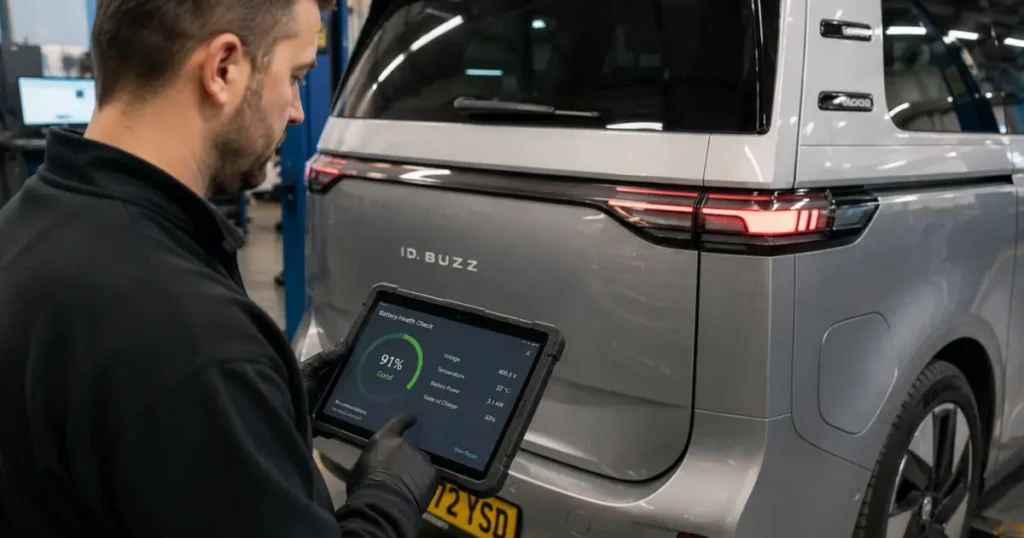
No other single check on a used ID. Buzz matters more than this one. The battery is the most expensive component in the car by a significant margin. Buying without a health check on a 60,000-mile example is the equivalent of buying a high-mileage diesel without a compression test.
What’s a Healthy Battery SoH on a Used ID. Buzz?
- Above 90% SoH excellent; expect minimal real-world range loss
- 80–90% SoH: good; normal for a pack covering 40,000–80,000 miles with mixed charging habits
- Below 80% SoH: this is the VW battery warranty threshold. At this level, push for a warranty repair or negotiate hard on price
VW’s high-voltage warranty states that for eight years or 100,000 miles, the battery should retain a minimum of around 60 kWh usable capacity. Below that threshold, VW may replace or repair the pack under warranty if used correctly. That warranty threshold is your negotiating floor on any degraded battery.
How to Check Battery Health in the UK
Three practical options for UK buyers:
- VCDS diagnostic tool: VCDS (from official Ross-Tech UK distributor V-Tech) works with all current VW models and reads high-voltage battery parameters at the dealer level. Ask any selling dealer for a printed VCDS readout showing the state of health and maximum energy content before you commit.
- OBDeleven or ELM327 OBD adapter: like other MEB-platform VWs, the ID. Buzz exposes detailed battery data over the OBD-II port, including maximum energy content and cell voltages. Many owners use tools like OBDeleven or ELM327-based dongles paired with apps such as Car Scanner or EV-specific apps that support VW MEB cars.
- Independent EV battery check specialists: services such as EV Battery Check in the UK offer pre-purchase battery diagnostics and issue written reports. Worth the cost on any 60,000+ mile example.
Charging History Red Flags
Frequent 0–100% DC fast charging is harder on battery chemistry than regular home wallbox use. Ask the seller or check via service records whether the car lived primarily on a 7kW home wallbox or motorway rapid chargers.
A Buzz that lived on home Level 2 charging and only fast-charged on road trips will typically show less degradation than one that fast-charged daily.
Also, check for any stored high-voltage fault codes in the service history. A clean fault history on a high-mileage car is a strong positive signal.
Battery Warranty | Confirm Transferability in Writing
The 8-year/100,000-mile VW battery warranty is transferable, but you must confirm this in writing with the selling dealer before purchase. Verbal confirmation is not sufficient. Get the remaining warranty duration and transferability confirmed on the sale paperwork.
Step 3: Real-World Range Expectations at Higher Mileage
WLTP vs Real-World UK Figures
WLTP figures for the ID. Buzz ranges from 258 miles on the early 77 kWh SWB up to 293 miles on the LWB. Real-world UK figures are consistently lower:
- Mixed driving, mild weather: 200–230 miles
- Motorway cruising, mild weather: 190–210 miles
- Motorway driving, winter cold: 150–175 miles on a healthy pack
On road trips, plan around the range from about 10–80% state of charge. That’s the useful window for balancing battery health, comfort, and charging time. At motorway speeds, the comfortable usable range is often around 70% of the pack.
How Mileage Affects Range
A 10% battery capacity hit still leaves the ID. Buzz with roughly 200-plus miles of real-world range in mild conditions, which remains sufficient for most UK driving patterns.
The heat pump is the single most important specification to check for winter range. Without it, cold weather drops noticeably faster. With it, the penalty is significantly reduced.
Planning Charging on UK Roads
The ID. Buzz uses CCS (Type 2 combo) charging, which is compatible across the entire UK public charging network. The maximum DC charging speed is 170 kW on earlier SWB models and up to 200 kW on later packs. Use Zap-Map for live UK charger availability.
BP Pulse, Pod Point, Osprey, and Gridserve cover the main motorway corridors. For home charging, a 7kW single-phase wallbox is the standard installation and covers overnight recharging in under twelve hours from a typical daily use level.
Step 4: Interior, Practicality, and Camper Potential
VW ID. Buzz Interior Overview
The ID. Buzz interior is genuinely different from any other electric family vehicle. The upright seating position, large glass area, and sliding rear doors create a cabin that feels more spacious than the external dimensions suggest.
Standard equipment on Style and above includes a 10-inch touchscreen with wireless Apple CarPlay and Android Auto, ambient lighting, and the Buzz Box central storage divider.
One known issue in early 2022–23 examples: infotainment glitches affecting navigation, CarPlay connectivity, and camera feeds. VW’s over-the-air update system pushes software fixes remotely, so the car’s current software version matters.
Ask for the current software version and confirm the car has received all available OTA updates before viewing. Unresolved software issues on a used car cost time and dealership visits to fix.
Seating Configurations by Variant
- SWB: Five-seat standard layout, or optional six-seat captain’s chair configuration
- LWB: Seven seats with fold-flat third row; rotating captain’s chairs available on Style and GTX LWB test the rotation mechanism on any used example
Boot Space and Practicality
| Configuration | Boot volume |
| SWB, all seats in use | 1,121 litres |
| SWB, rear seats folded | 2,205 litres |
| LWB, all seven seats in use | 306 litres |
| LWB, third row folded | 1,340 litres |
Check the Flexboard variable boot floor is present and undamaged on any used example. It is not expensive to replace as a standalone part, but its absence suggests a car that may have been used harder than the mileage suggests.
ID. Buzz as a Camper | What High-Mileage Buyers Should Know
The ID. Buzz is not a factory campervan, but it converts well. With all rear seats folded flat, the load floor is level and approximately 2.2 meters in length, which accommodates most adults for overnight sleeping.
Current aftermarket conversion companies in the UK install pop-tops, kitchen units, and storage systems into the ID. Buzz shell.
Although VW planned a California camper variant, it is unlikely to arrive in UK dealerships anytime soon. Any used ID. Buzz, currently advertised as a camper, will be an aftermarket conversion. Check whether the conversion work was carried out by a VAT-registered specialist and whether it affects the remaining manufacturer warranty.
One important note for camper buyers: V2L (vehicle-to-load) bidirectional charging is not currently available on UK-specification ID. Buzz models, which limit off-grid power use compared to some competitors. Running external appliances requires a separate leisure battery or generator.
Towing
- RWD models (Life, Style SWB): 1,200kg braked trailer
- GTX 4Motion: 1,800kg braked trailer
If the car is advertised with a tow bar, check the electrically retractable mechanism for smooth operation and inspect the coupling for wear. Replacement tow bar components on the ID. Buzz is not cheap.
Step 5: UK-Specific Checks Before You Buy
This section covers checks that no other used EV guide covers for the UK market specifically, and every one of them applies before you sign.
HPI Check | Non-Negotiable
Run a full HPI check on any used ID. Buzz regardless of the seller. Check for outstanding finance, written-off history, stolen marker, and mileage discrepancy. Recommended UK services: HPI Check, AutoTrader Car Check, RAC Vehicle Check. The cost is under £30. Skipping it on a £35,000+ purchase is not a saving.
MOT History
Check the car’s full MOT history at no cost via the GOV.UK MOT history checker. Electric vehicles still require an annual MOT from three years old.
Look for advisory patterns across consecutive tests, recurring tire wear, suspension advisories, or brake-related flags to tell you how the car was driven and maintained.
Recall and OTA Update Status
Check the DVSA recall database by VIN for any outstanding safety recalls. Key items to verify on early ID. Buzz models include infotainment software recalls, sliding door seal issues, and any high-voltage system notices. Confirm all over-the-air software updates have been applied and ask for the current software version number.
Charging Infrastructure at Home
Confirm you can install a home charger before purchasing. OZEV-registered installers qualify for the UK government’s EV chargepoint grant.
For renters, check your landlord’s and the building’s permission before buying. An ID. Buzz without a home charger is significantly less convenient to run than one with a 7 kW wallbox.
Step 6: Test Drive Checklist for a High-Mileage ID. Buzz
Arrive with this checklist and work through it methodically:
- Cycle both power sliding doors multiple times; listen for hesitation, grinding, or incomplete closure
- Test all seating rows, check fold mechanisms, and confirm Flexboard is present and flat
- Run the infotainment through a full cycle: CarPlay or Android Auto connection, navigation, reversing camera, parking sensors
- Drive 10 minutes on a dual carriageway at 60–70 mph; listen for wind noise around the door seals, a known weak point on early SWB examples
- Test regenerative braking in both standard mode and B mode to feel for smooth, consistent deceleration
- Ask to plug into a Level 2 charger during the visit and confirm the onboard charger ramps to 11 kW.
- Inspect the 20-inch alloys for kerbing damage; replacement costs are high, and kerbing is common in a vehicle this wide
- Check panel gaps on the sliding doors and rear hatch; the large flat body panels show bodywork repair clearly
Step 7: Safety and Driver Assistance Systems
The ID. Buzz achieved a five-star Euro NCAP rating. Confirm the year of the test applies to the variant you are viewing. LWB models were rated separately from SWB.
Standard ADAS across the range includes adaptive cruise control with lane keep assist and autonomous emergency braking (AEB). On Style and GTX trims, 360-degree parking cameras are fitted to confirm all sensors are operational during the test drive by running a low-speed parking maneuver.
Check for any driver assistance software recalls or technical service bulletins via the DVSA database before purchase.
High Mileage VW ID. Buzz | Is It Worth the Risk?
| Mileage band | Battery risk | Value | Verdict |
| Under 30,000 miles | Low | Poor (overpriced in current market) | Only if the deal is genuinely strong |
| 30,000–60,000 miles | Low–Medium | Good | The sweet spot most used by buyers should target this band. |
| 60,000–80,000 miles | Medium | Very good | Get a full battery diagnostic; negotiate on the result. |
| 80,000–100,000 miles | Medium–High | Best price | Diagnostic essential; confirm warranty is still active. |
| 100,000+ miles | High | Cheapest entry point | Expert inspection only; battery warranty likely expiring |
The ID. Buzz is not a risky use if approached correctly. If your daily driving is under 80–100 miles, even a slightly degraded ID. Buzz Pack is more than sufficient for most use cases. The risk lies in buying without data, paying for a healthy car, and receiving a degraded one.
Where to Find a Used VW ID. Buzz for Sale in the UK
- AutoTrader: largest used inventory in the UK; filter by LWB vs SWB, not just by year
- Electrifying.com: EV-specialist listings with range and battery commentary
- Cazoo, Cinch: online-only retailers with return policies; pricing tends to be fixed but fair
- VW Approved Used: remaining manufacturer warranty included, higher price, but reduced risk
- Private (Facebook Marketplace, PistonHeads): lowest prices, but no consumer protection; a battery diagnostic is non-negotiable on any private purchase
One consistent tip across all channels: always filter by wheelbase (LWB or SWB) as a primary filter, not just by year. A 2024 SWB and a 2024 LWB are priced very differently and serve very different needs.
VW ID. Buzz Used Buying Questions
What mileage is too high for a used VW ID. Buzz?
Over 100,000 miles warrants a full independent battery diagnostic and careful warranty check. Between 60,000 and 100,000 miles is manageable if the battery SoH reads above 80%, and the VW 8-year/100,000-mile battery warranty remains active and is confirmed transferable in writing.
Does the VW ID. Buzz battery warranty transfer to a second owner?
VW’s 8-year/100,000-mile battery warranty is transferable. You must confirm this in writing with the selling dealer on the sale paperwork before purchase. Verbal confirmation from a salesperson is not a warranty document.
What is the real-world range of a used VW ID. Buzz in the UK?
On a healthy pack in mild conditions, expect 200–230 miles in mixed driving. Motorway cruising in cold winter weather can reduce this to 150–175 miles. A car whose battery has degraded to 85% SoH will return approximately 170–195 miles in mild mixed driving, still adequate for most UK use patterns.
Is the VW ID. Buzz a good used camper?
With all rear seats folded flat, the floor is level and approximately 2.2 meters in length, workable for overnight sleeping. It is not a factory campervan.
The planned VW ID. Buzz California campers are unlikely to reach UK dealerships in the near term. Any used example marketed as a camper will be an aftermarket conversion; verify the conversion specialist’s credentials and check warranty implications before purchase.
What should I check on a high-mileage VW ID. Buzz?
Battery SoH via VCDS or OBDeleven diagnostic, HPI check, MOT history on GOV.UK, DVSA recall status by VIN, current OTA software version, sliding door mechanism, Flexboard presence, and tire wear pattern across all axles.
What is the difference between the SWB and LWB VW ID. Buzz?
The SWB is 4.712 meters long with five seats and a 77–79 kWh battery. The LWB is 4.962 meters long with six or seven seats and an 86 kWh battery. The LWB commands a higher price at equivalent mileage. Only the LWB delivers a genuine seven-seat configuration.
Is the ID. Buzz GTX 4Motion worth paying extra for?
The GTX adds dual motors, 340 hp combined, and 1,800 kg towing capacity versus 1,200kg on RWD models. For towing or performance driving, the GTX justifies its premium. For family transport without towing, the extra cost rarely recovers over a typical ownership period.
How do I check for VW ID. Buzz software recalls in the UK?
Use the DVSA vehicle recall checker at gov.uk/check-vehicle-recall, entering the car’s VIN. This confirms any outstanding manufacturer safety recalls. For technical service bulletins that are not formal recalls, ask the selling dealer to run a dealer-level VW diagnostic check and provide a written result.