Best Castles in Germany: 20 You Actually Need to Visit

Germany doesn’t just have a lot of castles; it has more than any other country on earth. Somewhere in the region of 20,000 castles, fortresses, and ruins are scattered across its hills, river valleys, and mountain slopes.
Some are polished tourist attractions with hour-long queues. Others sit forgotten at the end of a forest track, visited by a handful of walkers on a good day.
Quick Answer: How many castles are in Germany?
Germany has an estimated 20,000 castles, castle ruins, and fortified structures, more than any other country in the world. Bavaria holds the highest concentration, but the Rhine Valley, Moselle Valley, and Baden-Württemberg are equally rich in castle history.
So which ones are worth your time? That depends on what you’re after. If you want the famous castles in Germany that appear on every postcard, they’re here.
If you’d rather skip the coach-tour crowds and find something genuinely special, those are here too. This guide covers 20 of the best castles in Germany to visit, split by region and castle type, with honest visiting tips so you actually enjoy the experience rather than spending half of it in a queue.
Where Germany’s Castles Actually Are
Before diving into individual castles, it helps to understand how Germany’s castles cluster geographically. The castles in the German map aren’t random; history and geography explain everything.
Bavaria (South): Home to the famous 19th-century Romantic palaces of King Ludwig II, including Neuschwanstein. Also has some of Germany’s oldest medieval strongholds around Nuremberg and Burghausen.
Rhine & Moselle Valleys (West): The most castle-dense stretch of land in the country. Medieval lords built towers and fortresses on every bend of the Rhine between Koblenz and Mainz. The Moselle hides quieter gems like Burg Eltz and Cochem.
Baden-Württemberg (Southwest): Hohenzollern country. Stunning hilltop castles with panoramic views across the Swabian Alb, plus Heidelberg’s iconic ruins.
Northeast (Thuringia, Saxony, Mecklenburg): Fewer tourists, serious history. Wartburg Castle is UNESCO-listed. Schwerin sits on an island in a lake and looks like something from a fairy tale.
The Famous Castles in Germany Everyone Puts on Their List
These are the heavy hitters of the castles that appear in travel magazines, inspired movie sets, and draw millions of visitors every year. They’re famous for good reason.
1. Neuschwanstein Castle | Bavaria
Bavaria Romantic Palace Very Busy Jul–Aug
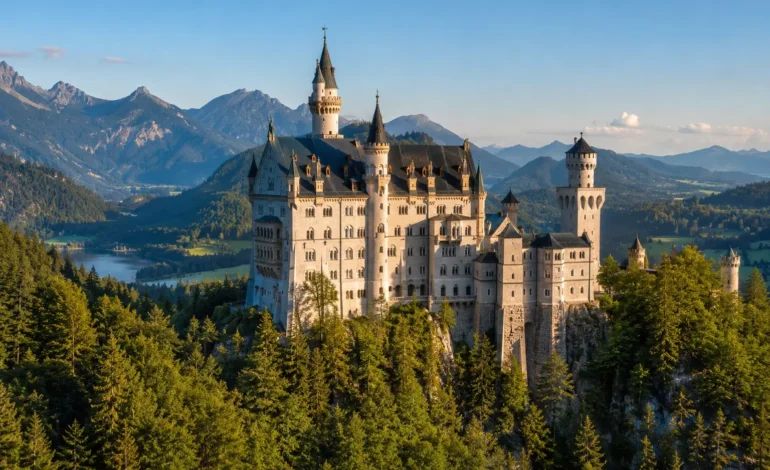
King Ludwig II commissioned Neuschwanstein in 1869, not as a military fortress but as a personal fantasy, a stage set for his obsession with Wagner’s operas and medieval chivalry.
The result is one of the most dramatic buildings in Europe: white limestone towers rising above the Bavarian Alps near the village of Schwangau.
Walt Disney visited in the 1950s and used it as the blueprint for Sleeping Beauty Castle. Around 1.3 million people visit each year, making it Germany’s most visited monument.
The lavish interior is genuinely worth seeing. Every room tells a story from German legend, all painted with extraordinary detail. The Singers’ Hall on the fourth floor is the standout.
Best photo spot: Walk up to Marienbrücke (Mary’s Bridge), which spans the gorge directly above the castle. It’s the view you’ve seen a thousand times online, and it really does look like that.
📅 Book tickets online at least three days in advance; they sell out fast. Visit April–May or October for shorter queues. Avoid the July–August peak if at all possible.
2. Hohenzollern Castle | Baden-Württemberg
Baden-Württemberg Royal Palace Moderate
Perched on an isolated peak in the Swabian Alb, Hohenzollern looks like someone placed a castle on top of the world and dared anyone to reach it.
The current building dates from 1842, but a castle has stood on this hill since the 13th century. It’s still privately owned by the House of Hohenzollern, the family that once ruled Prussia, and the guided tour takes you through rooms where Prussian royal artifacts, including the Crown of Wilhelm II, are still on display.
For the best view of the castle itself, drive to the nearby Zeller Horn viewpoint and hike fifteen minutes through the woods, and you’ll find the whole building framed against rolling hills and autumn foliage. It’s one of Germany’s great free viewpoints.
📅 The 45-minute guided tour is worth taking. Kids can dress up in period costumes, and the castle runs activities for younger visitors. A shuttle bus runs from the car park at the foot of the hill.
3. Heidelberg Castle | Baden-Württemberg
Baden-Württemberg Ruin & Palace Busy Year-Round
Heidelberg’s castle is a ruin, and that’s exactly what makes it so powerful. Perched on a forested hillside above one of Germany’s most romantic university towns, the castle is a mixture of Renaissance and Gothic stonework, partially destroyed by French forces in the 1690s and never fully rebuilt.
The result is a ruin with a real atmosphere: roofless great halls open to the sky, vast red sandstone walls, and views down over the Neckar River and Heidelberg’s old town.
Inside the surviving sections, the German Apothecary Museum is one of the most absorbing museum collections in the country, a full survey of pharmacy through the centuries. The castle wine cellar houses one of the world’s largest wine barrels, with a capacity of over 220,000 liters.
📅 Take the historic funicular from the town center. Summer evenings see open-air concerts and theater performances on the castle grounds; so check the program before you visit.
4. Nuremberg Castle | Bavaria
Bavaria Imperial Fortress Moderate
Nuremberg Castle is one of the most significant medieval castles in Germany, not because of its architecture alone, but because of what it represented for centuries.
The Holy Roman Emperors chose it as their primary imperial residence, and every German king from the 11th to the 15th century was expected to hold his first imperial diet here.
The castle complex crowns the old city of Nuremberg on a sandstone ridge, and its ramparts offer one of the best views of any German city.
The deep well inside the castle, sunk 47 meters through solid rock, is a small engineering marvel worth the stop. The twin-chapel structure, with separate floors for the emperor and the common people, is another detail that brings the medieval hierarchy to life.
📅 Combine with a walk along Nuremberg’s old city walls. Entry to the castle includes the deep well and the Sinwell Tower, climb it for a 360-degree city panorama.
5. Schwerin Castle | Mecklenburg-Vorpommern
Northeast Germany Romantic Palace Light
Schwerin Castle sits on a small island at the edge of a lake in the state capital of Mecklenburg-Vorpommern, and its golden-tipped spires reflect off the water in a way that genuinely stops you mid-step.
It’s sometimes called the “Neuschwanstein of the North,” which is fair in terms of spectacle, though it predates Ludwig’s palace by several decades and has a far more complex history.
The castle was home to the Mecklenburg royal family for centuries; today, half of the building serves as the state parliament, while the other half is a carefully restored museum of royal apartments.
Because it’s in the northeast and off most tourist itineraries, you’ll often find yourself almost alone in the gardens, a marked contrast to Bavaria’s flagship castles.
📅 The rear gardens and grotto are particularly impressive on a sunny day. Schwerin’s city center is compact and walkable, paired with the castle, with lunch on the main pedestrian street.
6. Wartburg Castle | Thuringia
Thuringia Medieval Fortress Light–Moderate
Wartburg is the real thing, a medieval hilltop fortress above the town of Eisenach that has stood largely unchanged for nearly a thousand years.
UNESCO added it to the World Heritage List in 1999, and the reasons are stacked: it was the home of Saint Elisabeth of Hungary, the supposed setting of a legendary medieval singing contest, and the place where Martin Luther translated the
The New Testament was translated into German in 1521 while hiding from the Holy Roman emperor. That translation shaped the modern German language.
The Romanesque great hall, the Palas, is one of the best-preserved medieval interiors in Central Europe. It doesn’t feel like a museum; it feels like history that hasn’t quite finished yet.
📅 Wartburg gets significantly fewer visitors than the Bavaria giants, which makes it easier to absorb. The uphill walk from Eisenach takes about 30 minutes; horse-drawn carriages are also available.
Medieval Castles in Germany Worth the Detour
These are the ones serious castle-goers rate above the famous icons, harder to reach in some cases, but far more rewarding for the effort.
7. Burg Eltz | Rhineland-Palatinate
Moselle Valley Medieval Fortress Moderate (go midweek)
Burg Eltz is the one castle in Germany that reliably makes people stop and stare. It sits deep in a forested valley above the Moselle River, completely hidden from the road.
You don’t see it until you come around a bend in the footpath and it appears through the trees: a cluster of towers and turrets that looks like several castles fused together over centuries.
That’s essentially what it is. Three noble families each built their own residence within one shared fortification, and you can still walk through the rooms that resulted.
What sets Burg Eltz apart from almost every other castle in Germany is that it has never been destroyed. It survived centuries of warfare through a combination of diplomacy and strategic marriages.
The House of Eltz has owned it since the 12th century, thirty-three generations ago. The furniture, tapestries, and silverware you see inside are genuinely 500 years old.
Best approach: Park at the Münstermaifeld or Moselkern car park and walk 15 minutes through the forest. The approach on foot is half the experience.
📅 Open April to October only. Midweek visits are significantly quieter. The guided tour is the only way to see the interior for 45 minutes.
8. Rheinfels Castle | Rhineland-Palatinate
Rhine Valley Medieval Ruin Light
Rheinfels was the mightiest castle on the Rhine, a fortress so formidable that it held off a siege of 28,000 French troops in 1692, the only Rhineland castle to resist Louis XIV’s assault.
The French Revolutionary army finally destroyed it in 1797, and it spent much of the 19th century being quarried for building stone. What remains is a vast, atmospheric ruin that looms over the village of St Goar like a sleeping giant.
The underground tunnel system is the highlight. Pick up a torch at the entrance and crawl through a 200-meter network of passages that the castle’s defenders packed with explosive booby traps designed to kill approaching invaders. It’s pitch-dark, muddy, and genuinely claustrophobic. Children tend to love it.
📅 A torch is provided at the entrance, but bring a spare if you have one. Wear clothes you don’t mind getting muddy. The castle connects to a hotel; staying overnight is possible and dramatically atmospheric.
9. Marksburg Castle | Rhineland-Palatinate
Rhine Valley Medieval Fortress Moderate
While most Rhine Valley castles are either ruins or later reconstructions, Marksburg is the exception: the only hilltop castle on the Rhine that was never destroyed and never significantly rebuilt.
What you see is what medieval soldiers actually lived and fought in. The castle rises above the Rhine near Braubach and has been continuously occupied since the 13th century.
Its collection of medieval weapons and armor is one of the most comprehensive in Germany, and the great kitchen gives you an unvarnished picture of castle life as it actually was: practical, cramped, and smelling of woodsmoke.
📅 Guided tours run in English and German throughout the day. The castle is easily combined with a Rhine River cruise; most boats stop at Braubach or pass close enough to photograph Marksburg from the water.
10. Cochem Castle | Rhineland-Palatinate
Moselle Valley Medieval Fortress Light–Moderate
Cochem Castle perches high above the Moselle River, dominating the roofline of one of the most photogenic wine towns in Germany. The original fortress dates from 1000 AD, though the current building is largely a 19th-century neo-Gothic reconstruction after French forces razed it in 1689.
That history aside, it’s a deeply satisfying visit; the views down over Cochem’s half-timbered streets and the looping Moselle are worth the uphill walk alone.
The best view of the castle itself comes from the river. If you’re travelling through the Moselle Valley by car, board one of the hourly boat cruises from Cochem’s waterfront. An hour on the water gives you a perspective of the castle and the surrounding vineyard slopes that no road can match.
📅 Guided tours run on the hour. Cochem town is a destination in its own right; the Riesling wines produced on the slopes directly below the castle are some of the best in Germany.
11. Burghausen Castle | Bavaria
Bavaria Medieval Fortress Light
Burghausen Castle holds a record that most people have never heard of: at just over one kilometer in length, it’s the longest castle complex in the world.
Built by the Dukes of Bavaria-Landshut from 1255 onwards, it snakes along a narrow ridge above the Salzach River on the Austrian border, a series of six connected courtyards stretching from the main keep all the way to a small Gothic church at the far end. Walking its full length is genuinely unlike any other castle experience in Germany.
Each courtyard reveals something different: a grim armory, a view down to the river, a section of wall where you can see the repair work from different centuries. Climb up to the roof of the main keep for an unbroken panorama across the valley into Austria.
📅 Allow at least two hours to walk the full complex. The town of Burghausen below is extremely pretty and worth an afternoon. It hosts a major jazz festival each summer in the castle’s outer courtyard.
12. Burg Vischering | North Rhine-Westphalia
NRW Water Castle Light
Burg Vischering is a water castle, a double-moated medieval fortress in the small town of Lüdinghausen in North Rhine-Westphalia, about 40 kilometers south of Münster.
Built in 1271 for the Bishop of Münster’s administrative office, it’s neither the largest nor the most ornate castle in Germany. But it has something more important than scale: it’s one of those rare places where the setting and the structure work together perfectly.
The thick sandstone walls rise directly from the moat water, and a walkway between the two moats gives you the sensation of being surrounded by the castle on all sides.
The interior museum on medieval life is engagingly done, and the knights-in-armor exhibit is particularly good for anyone traveling with children. The castle was recently renovated for its 750th anniversary.
📅 Reach it by train from Dortmund or Hagen. Guided tours available. There’s a pleasant bistro in the rear courtyard, a good stop for coffee after the visit.
13. Altena Castle | North Rhine-Westphalia
NRW Medieval Fortress Very Light
Altena Castle has two claims to fame. The first is architectural; it’s a well-preserved hilltop fortress above the town of Altena with foundations over 900 years old, rebuilt between 1906 and 1909 in a style that aimed to capture “how a proper castle should look.”
The second is genuinely surprising: in 1914, a man named Richard Schirrmann opened the world’s first youth hostel inside these walls.
The original hostel dormitories are preserved as a small museum, a peculiar and fascinating corner of social history tucked inside a medieval fortress.
📅 Around 40km south of Dortmund; accessible by train via Hagen. Very few foreign tourists find their way here, which makes it all the more enjoyable.
Hidden Gems | Castles in Germany Most Visitors Miss
These five are genuinely off the main tourist trail. Lower crowd levels, often lower entry fees, and in some cases, better experiences than the famous names.
14. Lichtenstein Castle | Baden-Württemberg
Baden-Württemberg Romantic Castle Very Light
Described by its admirers as “the fairy tale of Württemberg,” Lichtenstein Castle clings to the edge of a cliff in the Swabian Alb with an audacity that makes Neuschwanstein look restrained.
The name means “shining stone,” and on a clear day, with the castle lit by morning sun against a drop into the forested valley below, the name earns its keep.
It sits just a short drive from Hohenzollern Castle but gets a fraction of the visitors in part because it’s less well marketed abroad, in part because the road to reach it is genuinely winding.
Guided tours are the only way inside, and they’re worth it. The interiors are richly decorated, and the collection of medieval weapons is impressive. The viewpoint from the castle grounds is one of the finest in the entire region.
📅 The car is the easiest option. Paid parking at the castle. There’s a restaurant and café on site for lunch and a morning visit when the light is best.
15. Mespelbrunn Castle | Bavaria | Hesse Border
Spessart Region Water Castle Very Light
Just an hour’s drive from Frankfurt, Mespelbrunn sits in a small forest pond as if someone placed it there for a painting. The original property was granted to a knight by the Archbishop of Mainz in 1412, and the castle has stayed in the same family ever since.
The Brothers Grimm are said to have visited and drawn inspiration from the distinctive tower; it’s easy to see why. The courtyard is tiny and enclosed, the tower rises above a single doorway several meters off the ground, and the reflection of the whole structure in the pond water does something to your sense of reality.
📅 Works perfectly as a half-day trip from Frankfurt. Very few international tourists visit. The surrounding Spessart Forest is one of the largest continuous forests in Central Europe and is worth a walk before or after.
16. Leuchtenburg Castle | Thuringia
Thuringia Medieval Fortress Very Light
Leuchtenburg sits on a hilltop about 20 kilometers from Jena and offers something no other castle in Germany does: an award-winning interactive museum dedicated to the history of European porcelain, housed inside a 12th-century fortress.
The Porcelain Worlds exhibition is genuinely engaging; you’ll find the world’s tallest vase alongside the world’s smallest coffee pot, and the exhibition design is far better than the subject matter might suggest. The castle itself also has a Skywalk, a viewing platform with panoramic views across the Saale Valley.
📅 Day-trip friendly from Jena, Weimar, Erfurt, or Leipzig. Often combined with the nearby Wartburg as part of a Thuringia castle route.
17. Stahleck Castle | Rhineland-Palatinate
Rhine Valley Medieval Fortress (Hostel) Light
Stahleck Castle towers above the Rhine wine village of Bacharach, a near-perfect medieval fortress perched on a steep slope above the river. Its particular distinction is that it has been converted into a youth hostel.
You can sleep in a Rhine Valley castle for around €30 per night in a dormitory bed, or rather more in a private room. Waking up to Rhine Valley views from an 800-year-old fortress is, objectively, a good way to start a day.
Even if you don’t stay, the castle is freely accessible, and the views from its walls across the river and the surrounding vineyards are outstanding.
📅 Book ahead in summer; the hostel is popular with German travelers who know about it. Bacharach itself is one of the most intact medieval wine towns on the Rhine, worth at least half a day on foot.
18. Hohenschwangau Castle | Bavaria
Bavaria Royal Palace Moderate
Neuschwanstein gets all the attention, but its immediate neighbor, Hohenschwangau Castle, is the one that shaped the man who built it. This is where King Ludwig II grew up.
His father, Maximilian II, rebuilt the original medieval castle here in the 1830s and filled it with murals depicting the German heroic legends that would become Ludwig’s lifelong obsession. Standing in Hohenschwangau and looking up at Neuschwanstein, you can actually see where Ludwig’s fantasy began.
The interiors are warmer and more personal than Neuschwanstein’s theatrical grandeur; this was a family home first. The banquet hall, with its walls covered in scenes from the Wilkina Saga, is particularly memorable.
📅 Tickets for both Neuschwanstein and Hohenschwangau are sold through the same booking portal. Arrive early; a horse-drawn carriage runs up the hill if you’d rather not walk.
19. Würzburg Residence | Bavaria
Bavaria (Franconia) Baroque Palace Moderate
Technically a palace rather than a castle, Würzburg Residence earns its place on any German itinerary as the most complete example of Baroque architecture in Europe, a UNESCO World Heritage Site built in pure Baroque style over roughly one hundred years, with no architectural intrusions from other periods.
Its great staircase ceiling, painted by Tiepolo, is one of the largest ceiling frescoes in the world. The mirrored hall is unique on the continent. Strict no-photography rules apply inside, which actually improves the experience considerably.
📅 About 90 minutes from Frankfurt on the Romantic Road. The palace garden behind the building is free to access and ideal for a picnic. Self-guided and guided tour options are both available.
20. Pfalzgrafenstein Castle | Rhineland-Palatinate
Rhine Valley Medieval Fortress Very Light
Pfalzgrafenstein doesn’t sit on a hill or a clifftop; it sits on a small island in the middle of the Rhine, accessible only by ferry. Built in 1326 as a toll station for river traffic, its pentagonal shape was designed to deflect ice floes in winter and cannonballs in wartime.
It never fell to an enemy. Together with Gutenfels Castle on the bank above, it formed a pincer point that no Rhine merchant could pass without paying the toll. From the riverbank, the castle looks almost impossibly small, a stone ship moored in the middle of a fast river.
📅 A small passenger ferry runs from the village of Kaub. Opening hours are limited in advance. Best experienced as part of a Rhine Valley drive between Koblenz and Rüdesheim.
Castles in Germany You Can Actually Stay In
Germany has a genuinely impressive range of castle accommodation, and the gap between the cheapest and most expensive is wider than you’d expect.
At the budget end, converted castle hostels like Stahleck in Bacharach put a Rhine Valley fortress bedroom within reach for around €30 a night. Jugendherberge Altena, set in the very castle that founded the global youth hostel movement, offers a similar deal in NRW.
At the upper end, Althoff Schloss Bensberg near Cologne is a 5-star Baroque palace hotel with one of the best restaurants in the region. Schloss Fleesensee in Mecklenburg, a Radisson Blu resort built around a castle complex, offers lake views, golf, and spa facilities.
For a current list of castle hotels across all price ranges, search “castle hotels Germany” on your preferred booking platform. The variety is wide, and many don’t appear on the main hotel aggregators unless you look specifically.
Best Time to Visit Germany’s Castles
| Season | Pros | Cons |
| Spring (Apr–May) | Wildflowers in bloom; queues thin, and Burg Eltz reopens in April | Some smaller castles are still closed in early April; weather variable |
| Summer (Jun–Aug) | All sites open; long daylight hours; outdoor events at Heidelberg and Burghausen | Neuschwanstein and Heidelberg are severely overcrowded July and August |
| Autumn (Sep–Oct) | Foliage transforms the hillsides; crowds thin dramatically after mid-September; harvest season in the Rhine and Moselle wine regions | Shorter opening hours; some smaller castles close from October |
| Winter (Nov–Mar) | Neuschwanstein in snow is genuinely magical; almost no queues; dramatic atmosphere | Many castles closed or reduced hours; some access roads icy; fewer guided tour options |
FAQ
How many castles are in Germany?
Germany has an estimated 20,000 castles, castle ruins, and fortified structures, more than any other country in the world.
Bavaria has the highest concentration, but the Rhine and Moselle Valleys are densely packed, with a castle visible from nearly every bend in the river.
Which German castle inspired Disney?
Neuschwanstein Castle in Bavaria. Walt Disney visited in the 1950s and used its alpine setting and fairy-tale towers as the design inspiration for Sleeping Beauty Castle at Disneyland and later for Cinderella Castle at Walt Disney World.
Is Burg Eltz free to visit?
No. Entry to Burg Eltz costs approximately €12–€14 for adults (check the official website for current pricing). The castle is open from April through October. The guided tour, included in the ticket price, is the only way to see the interior, and it’s well worth the fee.
What is the oldest castle in Germany?
This is genuinely difficult to pin down because many castles have been rebuilt multiple times on ancient foundations.
However, Marksburg Castle on the Rhine is widely cited as the oldest continuously inhabited hilltop castle in Germany. Several Rhine Valley castles have foundations dating to the 8th and 9th centuries.
Can you stay overnight in a German castle?
Yes, and the range is wider than most people expect. Budget options include castle hostels like Stahleck in Bacharach from around €30 per night.
At the luxury end, hotels like Althoff Schloss Bensberg near Cologne offer 5-star palace accommodation. Many castle hotels don’t appear prominently on standard booking sites, so search specifically for “Schloss Hotel” or “castle hotel Germany.”
What is the most visited castle in Germany?
Neuschwanstein Castle, with around 1.3 million visitors per year, is Germany’s most visited castle and the most visited monument in Bavaria. On peak summer days, the queues for timed entry tickets can stretch for hours; booking online well in advance is strongly recommended.
Bottom Line
The sheer number of castles in Germany means you could spend months visiting them and still not reach the end of the list.
But the 20 on this guide represent a genuine cross-section from the unmissable famous names to the hidden corners that most international visitors completely overlook.
If you only have time for one, Burg Eltz and Neuschwanstein are the two that leave the deepest impression for opposite reasons.
Eltz for its stillness and improbable survival across eight centuries; Neuschwanstein for sheer theatrical spectacle. Between them, they capture the two sides of Germany’s castle story perfectly.
For anyone planning a wider tour, the Rhine and Moselle Valley route — picking up Pfalzgrafenstein, Rheinfels, Marksburg, Burg Eltz, and Cochem in a single road trip is one of the most rewarding drives in Central Europe.
Add Lichtenstein and Hohenzollern in Baden-Württemberg for a perfect long weekend, and you’ll come back with enough castle photographs to last a lifetime.